Key Takeaways:
- Modern contemporary interior design is warm minimalism, not cold restraint. It combines clean lines and open spaces with natural materials, warm lighting, and personal touches that make a Singapore contemporary home feel calm, generous, and distinctly yours.
- Good contemporary interior design starts with how you live, not how a space looks. At 6AM Spaces, every contemporary interior begins with the individual — your morning routines, your storage habits, your relationship with light — because contemporary interiors that work for your life will feel beautiful for years.
- Plan for the realities, not just the vision. Carpentry lead times, HDB permits, and waterproofing curing periods are non-negotiable. Understanding the timeline means fewer surprises and a smoother path to contemporary interiors you’ll love coming home to.

Singapore homeowners are drawn to contemporary modern interior design for good reason. In a city where homes range from compact BTO flats to generous landed properties, modern contemporary interior design offers the balance between clean lines and lived-in warmth — open spaces that breathe, natural materials that age gracefully, and layouts shaped around the way you actually live. Modern contemporary design has become the most requested design style among homeowners renovating HDB flats and condos because it feels like home from day one.
At 6AM Spaces, we design contemporary interiors that reflect the individual — not a template. Our name evokes the quiet clarity of early morning: a time of possibility, fresh perspective, and calm intention. Every space is unique and reflective of every individual. Modern contemporary interior design, done well, is never about following current trends blindly — it is about crafting contemporary interiors that feel timeless, personal, and warm.
What Is Contemporary Modern Interior Design?
Modern contemporary interior design blends the clean lines and functional simplicity of mid-century modern design with the fluid, constantly evolving sensibility of contemporary style — prioritising natural materials, neutral colour palettes with bold accents, and uncluttered spaces that feel personal rather than sterile.
Modern interior design refers to a specific historical movement (1920s–1950s), while contemporary interior design is fluid, reflecting the spirit of the present moment. In Singapore-home terms, think of modern contemporary design as warm minimalism: natural timber tones layered with durable neutral finishes, soft ambient lighting, and tactile textures — a living space that feels calm and unhurried at any hour, not a showflat frozen in time. Contemporary interior design ideas draw from both traditions, creating modern contemporary interiors that are constantly evolving yet grounded in timeless neutrals and natural elements.
Contents
- Key Characteristics of Modern Contemporary Interiors
- Colour Palette and Material Choices
- Lighting That Sets the Mood
- Storage That Disappears
- Compact-Space Planning for HDB and Condo
- Process and Timelines for Singapore Renovations
- FAQs
Key Characteristics of Modern Contemporary Interior Design
Contemporary interior design is constantly evolving. Unlike modern design, which refers to a specific mid-twentieth-century movement defined by straight lines, wood elements, and a limited colour palette, contemporary design reflects current trends while remaining rooted in clean lines, open spaces, and a neutral colour palette. The key characteristics of modern contemporary interiors include clean lines without coldness, open floor plans that encourage natural light to travel deep into every room, and uncluttered spaces where every element serves a clear purpose. These are the most prominent characteristics that set contemporary interiors apart.
Contemporary furniture in modern contemporary interiors favours sleek lines and simple silhouettes, softened with curved forms that add visual interest. Statement pieces — a sculptural lamp, a textured feature wall, or a striking dining table — anchor the room. The contemporary design style values clean lines but frequently incorporates fluid, organic forms, creating modern contemporary interiors that feel inviting rather than rigid.
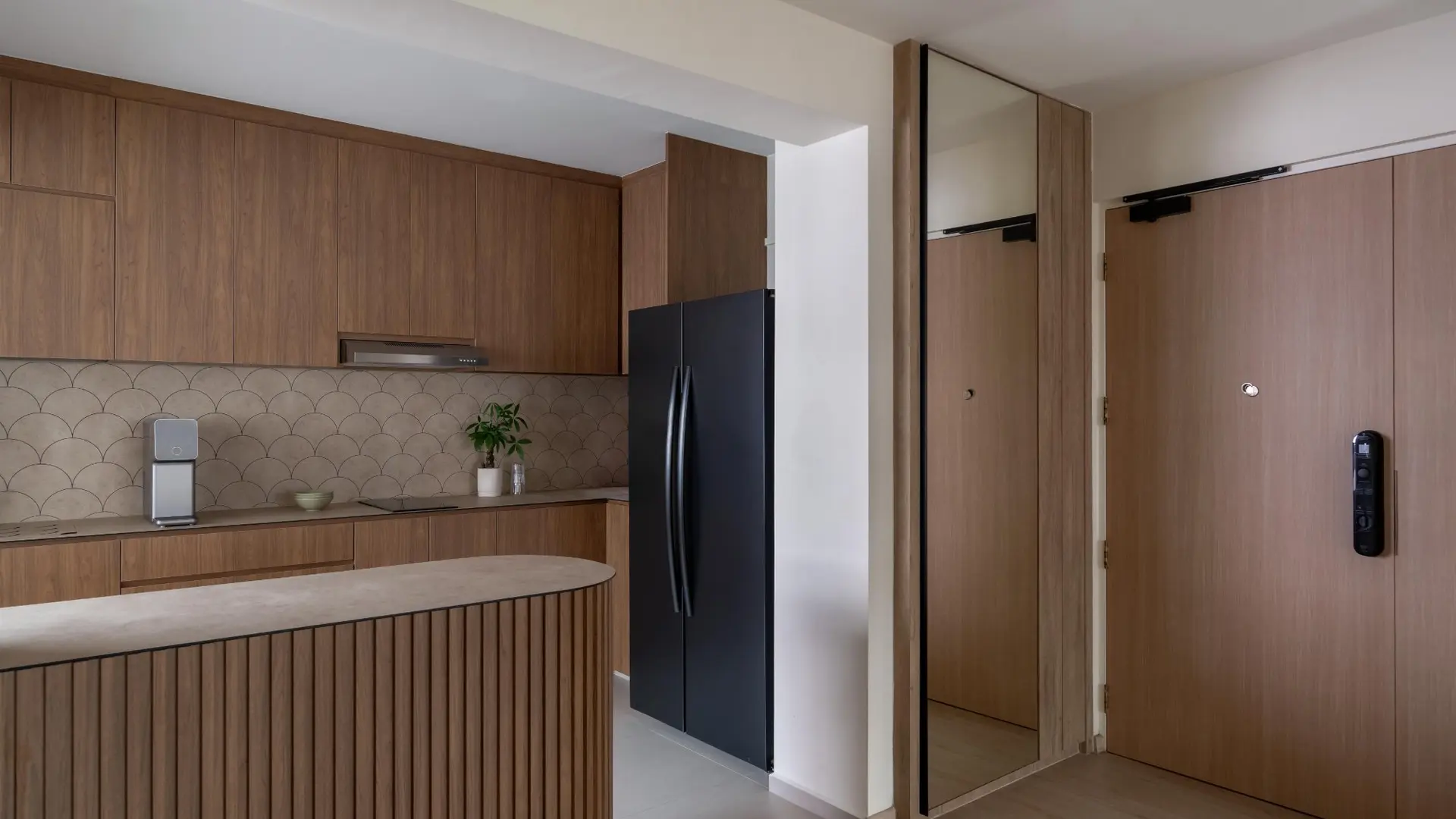
The contemporary kitchen in one of our projects demonstrates these key elements: full-height timber cabinetry in warm oakwood tones paired with a neutral white backsplash, achieving generous storage without visual noise. The overall aesthetic is calm, functional, and unmistakably personal — a stunning design that shows how modern contemporary design works in a real Singapore HDB.
Modern contemporary design also emphasises natural materials — timber, stone, and metal — because these natural elements add warmth that synthetic surfaces cannot replicate. Decorative elements are used sparingly but intentionally. This separates contemporary interior design from strict minimalism: contemporary design allows for decorative elements and cozy textures, while minimalism strips everything to essentials.
Good Morning Tip (Material): Choose laminates and veneers with visible wood grain over flat-colour finishes. They add wooden textures and visual interest to contemporary interiors, especially on large surfaces like kitchen cabinets and wardrobes, without the maintenance demands of solid timber.
Colour Palette and Material Choices for Contemporary Interiors
Colour is one of the most powerful design elements in crafting contemporary interiors that endure. The right colour palette elevates a room, making it feel spacious, light-filled, and cohesive.
The Neutral Foundation
Contemporary interior design ideas almost always begin with a neutral colour palette — warm whites, soft beiges, warm grey, and charcoal — that serves as a canvas for other elements to shine. Neutral walls bounce light through the contemporary home and create the timeless elegance that defines the modern contemporary design style. Neutral colours like cream, sand, and pale stone keep the overall aesthetic calm while adding depth through subtle variations. These neutral colors are the backbone of contemporary interiors worldwide, and in Singapore they make compact living spaces feel generous.
In Singapore’s humid climate, neutral hues and timeless neutrals are effective because they visually cool a contemporary space while warm neutrals prevent it from feeling clinical. The 6AM Spaces colour philosophy leans towards warm white (#F5F0EB) and cream (#EDE6DC) paired with burnished gold (#B8956A) and oakwood tones — a neutral color palette that feels lived-in from day one.
Bold Accents and Striking Contrast
A neutral colour palette alone risks appearing flat. Bold accents — whether olive green cushions, bolder tones on a feature wall, or matte black fixtures — inject personality while preserving the minimalist core of contemporary interiors. The 70/20/10 approach works well: 70% neutral, 20% secondary tones, and 10% bold accents for striking contrast and character. Bold accents and colour combinations give contemporary interior design its personality.
The kitchen in one of our projects uses warm scallop-patterned backsplash tiles as a contemporary design accent against full-height timber cabinetry. The textured surfaces — fluted panels on the kitchen island and the curved organic shelf feature — adds visual interest that keeps modern contemporary interiors feeling distinctive. These natural elements connect the contemporary home to something earthy, showing how bold accents need not be loud in contemporary interiors.
Cool tones through flooring or metallic fixtures create pleasant tension against the predominant warmth. Earthy tones in modern contemporary interiors foster connection to nature — something especially valued when your living space is on the 15th floor of an HDB block.
Good Morning Tip (Lighting): Pair warm-white LED strips (2700K–3000K) under kitchen cabinets for a gentle glow that enhances your colour palette and adds visual interest to modern contemporary interiors without additional light fixtures.

Lighting That Sets the Mood in Contemporary Interiors
Natural light is essential in contemporary interior design, and large windows are a prominent characteristic — they channel ample natural light deep into living spaces and create spaciousness that no artificial source can replicate. In Singapore HDB and condo homes, ample natural light is achievable by keeping window treatments minimal and sightlines open. Large windows and glass doors are among the key characteristics of modern contemporary interior design because they blur the boundary between indoors and out.
Thoughtful artificial lighting is equally important in modern contemporary interiors. Layered lighting — ambient, task, and accent illumination — is vital in any contemporary space. Recessed downlights provide the base, while track lighting highlights architectural features, textured walls, or artwork. Sculptural lamps and statement light fixtures double as contemporary décor, serving as artistic focal points. Statement pieces in lighting are among the key elements of the contemporary design style.
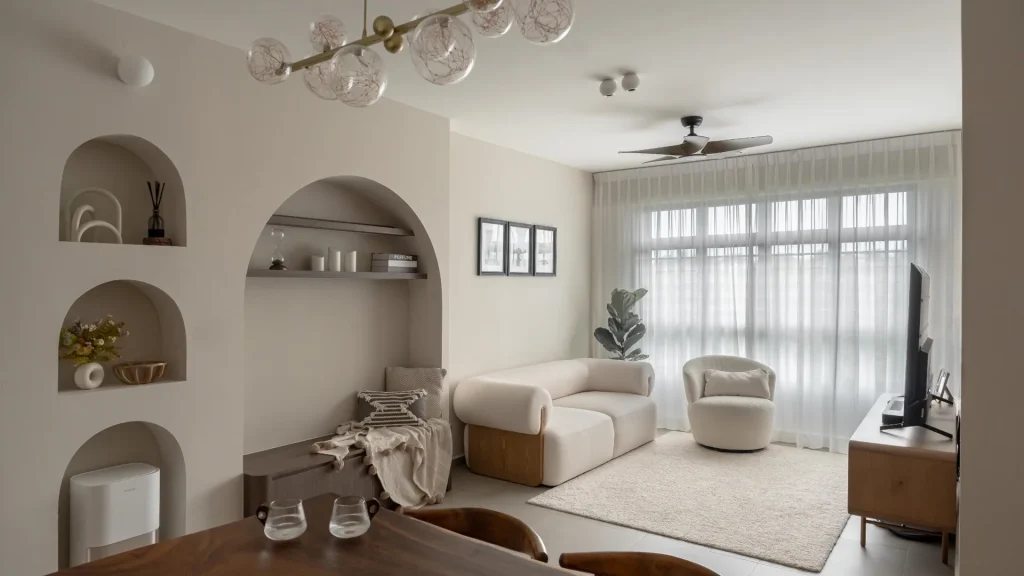
In another project, warm pendant lighting over the dining table in the dining room creates an intimate atmosphere within a broader open-plan layout. The glass-panelled partition wall between dining area and study allows natural light to travel — a modern aesthetic solution that keeps the contemporary home feeling generous even when rooms are functionally separated.
Lighting can dramatically influence mood and functionality. Think in “scenes”: dawn light through sheer blinds for morning calm, focused task lighting at the kitchen counter, and warm accent lighting for evening unwinding in the master bedroom or living space. In a contemporary dining room, the right pendant adds visual interest; in the master bedroom, layered lighting creates a retreat. Modern contemporary interiors treat light fixtures as both functional tools and design elements.
Storage That Disappears in Contemporary Interiors
One of the defining principles of contemporary interior design is that uncluttered spaces feel larger, calmer, and more inviting. In Singapore’s compact contemporary homes, storage must work harder and show less. Modern contemporary interior design solves this through clean lines, integrated carpentry, and a clear philosophy: everything in its place.
Full-height cabinetry uses every inch of vertical space while clean lines of handle-less doors keep surfaces seamless. In the Chelsea (Redhill) contemporary kitchen, timber cabinetry wraps around appliances, service yard, and utility areas in one continuous contemporary design, hiding everything within the same material language. The result is a stunning design — a contemporary kitchen that feels twice its actual size.
Modern contemporary interiors benefit from distinguishing what to hide and what to display. Everyday items belong behind closed doors. A few carefully chosen decorative elements — a ceramic vase, a small plant — belong on open shelves where they add personality.
In our Sumang Walk project, a sculpted organic wall niche replaces a conventional shelf unit. The curved form is both a display shelf and a design element — modern contemporary interiors merging function with artistic expression. These are the contemporary interior design ideas that make a real difference in how a contemporary home feels daily.
Good Morning Tip (Storage): In your entryway, consider a slim full-height shoe cabinet with a mirror panel. It consolidates shoe storage, last-look mirror, and a visual impression of open spaces into a single piece of contemporary furniture. Simple contemporary interior design ideas like this transform the feel of modern contemporary interiors.

Compact-Space Planning for HDB and Condo Contemporary Homes
Open floor plans are a hallmark of contemporary interior design, and in Singapore’s HDB and condo context, one of the most effective strategies for making a 3- or 4-room flat feel generous. By allowing the contemporary kitchen, dining area, and living room to flow into each other, you invite ample natural light to travel further and create sightlines that open up the living space. Open floor plans are a key characteristic of modern contemporary design because they make contemporary interiors feel spacious regardless of actual square footage.
Zoning in an open contemporary space relies on subtle cues: a change in flooring, a kitchen island with fluted panelling, a pendant light that anchors the dining table, or a glass partition. Glass doors between study and dining room allow natural light to pass while maintaining privacy. These other elements maintain the contemporary theme while giving each zone identity.
Multi-use corners are essential in compact contemporary homes. A dining table that doubles as a work-from-home desk, a window seat with hidden storage, walk in showers in the contemporary bathroom that eliminate the visual clutter of a shower screen — these choices add up. Contemporary design is characterised by a “less is more” approach, but in Singapore’s context, it is more accurately “less is more generous.” The modern aesthetic depends on clean lines, neutral colours, and smart spatial planning.
Geometric shapes in built-in carpentry — angled shelving, rounded island counters — adds visual interest while breaking up straight lines in a typical HDB layout. These architectural features soften modern contemporary interiors without compromising the overall aesthetic. Large windows remain essential: they bring natural light deep inside and connect modern contemporary interiors with the city outside.

Process and Timelines for Singapore Renovations
Renovating for modern contemporary interior design in Singapore involves navigating real-world constraints. Here is an honest overview of what to expect.
Process Summary
- Consultation → Share your lifestyle, preferences, and budget with your designer
- Concept development → Layout planning, material selection, 3D visualisation
- Permits and approvals → HDB renovation permit via your contractor (mandatory for wall hacking, floor works, plumbing changes)
- Carpentry and construction → Custom joinery, electrical, plumbing, painting
- Styling and handover → Final touches, defects check, move-in
What You Need to Know
HDB requires homeowners to engage a contractor from the Directory of Renovation Contractors (DRC) for all renovation works. According to HDB’s renovation guidelines, newly completed (BTO) flats typically have up to three months from the date of the renovation permit to complete all works, while resale flats are generally given a shorter window of approximately one month (note: specific timeframes may vary by project and estate — always confirm with HDB directly). Noisy work — hacking, drilling — is restricted to weekdays between 9 AM and 5 PM and must be completed within three consecutive days. General renovation work may be carried out between 9 AM and 6 PM on weekdays and Saturdays. No renovation work is permitted on Sundays and public holidays. Failure to comply with HDB renovation guidelines can result in fines of up to S$5,000 per violation under the Housing & Development (Renovation Control) Rules, plus mandatory removal of unauthorised work at the homeowner’s expense (source: HDB renovation guidelines).
For newly completed BTO flats, a three-year restriction period applies to bathroom wet works — you cannot hack or replace bathroom wall and floor tiles during this time, though you may overlay new finishes using adhesives. Even contemporary bathroom renovations must work within these constraints.
Condo renovations introduce additional MCST considerations — your management may require renovation deposits, specific elevator booking for material delivery, and adherence to building-specific work hours.
Common Bottlenecks (Honestly)
Carpentry lead times are the most common cause of delays. Custom joinery typically requires four to six weeks of fabrication after design confirmation. Permit approvals take two to three weeks. What can be accelerated: painting, electrical rough-in. What cannot: structural drying times, waterproofing curing, carpentry fabrication.
A well-planned contemporary renovation for a 4-room HDB typically takes six to ten weeks from permit to handover, depending on scope. Industry sources suggest budgets of approximately S$43,000–S$66,000 for a 4-room BTO and S$50,000–S$80,000 for a 4-room resale, though costs vary significantly based on material choices and carpentry scope.
Sustainable, Durable Finishes
In 2026, the contemporary design conversation increasingly includes sustainability — a current trend that aligns with the contemporary style’s emphasis on durable, timeless materials. Lower-VOC paints are widely available. Sintered stone surfaces offer exceptional durability. Timber-look laminates replicate natural wood warmth while offering superior moisture resistance — a practical choice for modern contemporary interiors that age gracefully.
Start Your Contemporary Home
Every space is unique and reflective of every individual. If you’re ready to explore what modern contemporary interior design could look like — shaped around your life, crafted with care — we’d love to hear from you.
FAQs
What is the difference between contemporary and modern interior design?
Modern interior design refers to the mid-century movement (1920s–1950s) with clean lines and limited palettes. Contemporary design is fluid, reflecting current trends. Modern contemporary design blends both — a design style that is timeless but never static. Contemporary style continues to evolve.
How much does a contemporary renovation cost for an HDB flat?
Industry estimates suggest a 4-room BTO contemporary renovation ranges from approximately S$43,000 to S$66,000, while resale flats typically cost S$50,000 to S$80,000 due to additional hacking and reinstatement work. Costs vary based on carpentry scope and material selections.
Can I achieve a contemporary look without hacking walls in my HDB?
Absolutely. Open floor plans can be suggested through furniture placement, consistent flooring, and sightline management. Glass doors, open shelving, and a unified neutral colour palette create contemporary interiors that feel open without structural changes — and without HDB permits.
How do I make a small HDB flat feel larger with modern contemporary design?
Use a neutral colour palette with warm white neutral walls and neutral colors throughout, keep contemporary furniture low-profile with sleek lines and clean lines, and maximise natural light through minimal window treatments. Neutral colours, large windows, and mirrors amplify light in compact modern contemporary interiors.
What materials work best for contemporary interior design in Singapore?
Choose natural materials that handle humidity: timber-look laminates, porcelain tiles with stone finishes, quartz or sintered stone countertops, and matte metal fixtures. These provide warmth and texture for modern contemporary interiors while standing up to Singapore’s climate.
How long does a contemporary HDB renovation take?
Most contemporary renovations take six to ten weeks from permit approval to handover. Custom carpentry fabrication (four to six weeks) is usually the longest lead item. Allow two to three weeks before that for permit processing and design finalisation.